
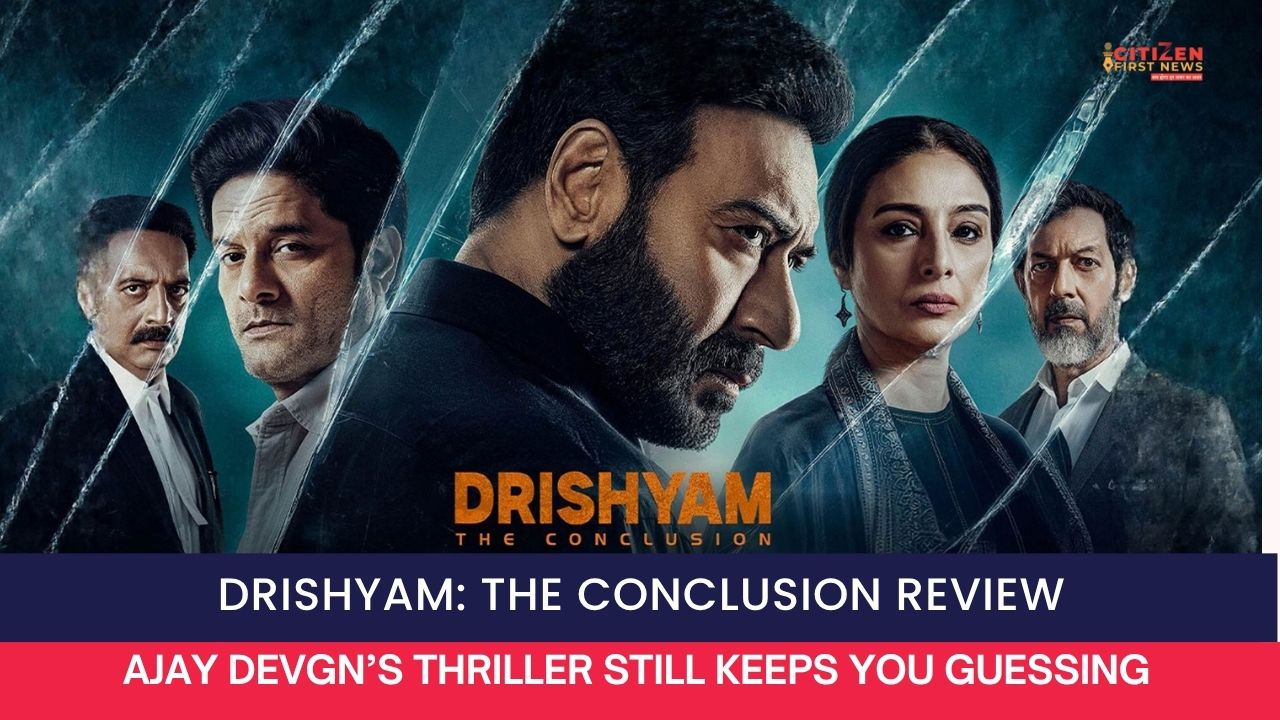
Drishyam: The Conclusion Review
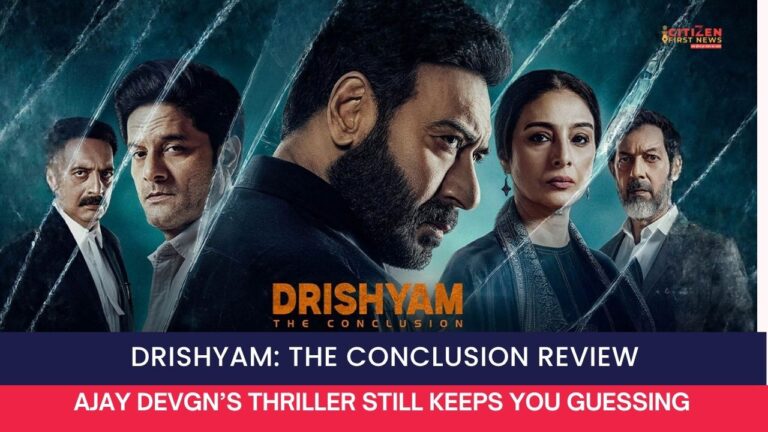
Drishyam: The Conclusion Review: It is completely reasonable to ask whether the Drishyam franchise really needed a third film. After all, the central idea—a father going to extraordinary lengths to protect his family after his daughter becomes involved in a killing—has already been explored through two Hindi films adapted from the Malayalam originals.
The question becomes even more valid when the third film, Drishyam: The Conclusion, chooses not to follow the story of the original Malayalam trilogy’s third instalment. Instead, it creates its own continuation.
On paper, that sounds risky. The franchise already has a very recognisable formula: dramatic background music, elaborate twists, police investigations, family secrets and Vijay Salgaonkar staying several steps ahead of everyone. Repeat that formula once and it feels exciting. Repeat it again and audiences start seeing the machinery behind it.
Surprisingly, Drishyam: The Conclusion manages to avoid becoming a completely predictable exercise. It is far from perfect, but there is an unexpected ease to the film. Unlike the first two Hindi instalments, which often invited comparisons with their Malayalam counterparts, the third film seems more comfortable being its own Bollywood thriller.
After years of watching the Salgaonkar family escape one crisis after another, the film does not pretend that it is bringing an entirely new concept. Instead, it plays with the familiarity of the franchise and turns some of that repetition into part of the entertainment.
Table of Contents
Why the Basic Story Still Works
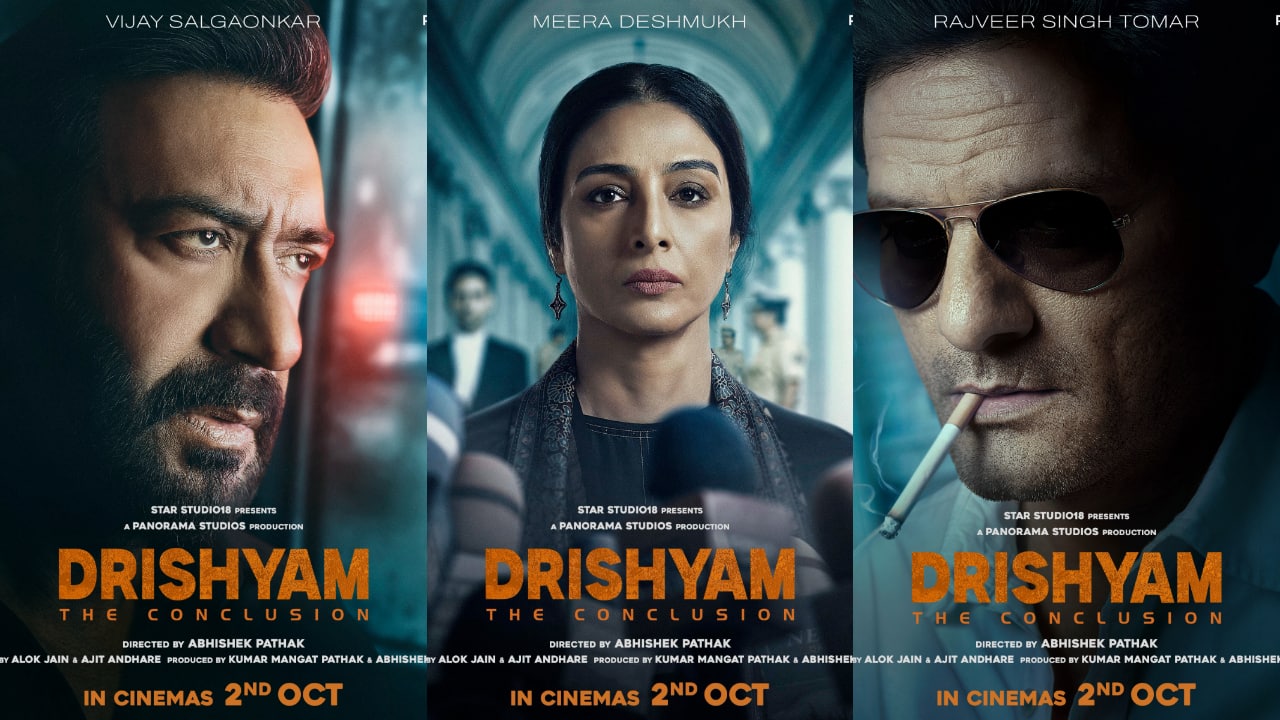
At the heart of Drishyam is a fairly simple idea. Vijay Salgaonkar is an ordinary man without money, influence or powerful connections. When he gets caught in a situation involving a much more influential family, the balance of power immediately becomes uneven.
The original killing may have happened in self-defence, but the aftermath is far more complicated. The victim’s parents understandably want answers, while Vijay and his family are forced to live with the consequences of their decisions.
That is what makes the central conflict interesting. There isn’t a conventional villain anymore. The person at the centre of the entire case is already dead. Instead, both sides believe they are fighting for justice.
The result is a strange moral battle where everyone has a reason to keep going.
Eventually, however, the film returns to what Drishyam does best: tricks, misdirection, carefully planted clues and last-minute revelations. Vijay’s calm body language and almost expressionless face become weapons in themselves.
The Franchise Knows It Is Repeating Itself
One of the more interesting things about The Conclusion is how aware it is of its own formula.
Rather than pretending that the franchise hasn’t repeated the same ideas, the film occasionally turns that repetition into humour. Sub-inspector Gaitonde, played by Kamlesh Sawant, becomes particularly useful in this regard.
As one of the few characters who has remained connected to the Salgaonkar case, Gaitonde carries the history of the previous films with him. His comments about October 2 and the recurring embarrassment surrounding the case provide some of the film’s lighter moments.
The arrival of SP Rajveer Singh Tomar, played by Jaideep Ahlawat, also changes the dynamic. Unlike officers who have previously dealt with Vijay, Tomar approaches the case without the emotional baggage of the past.
His investigation begins by questioning details that others had apparently overlooked. Why weren’t certain forensic tests conducted? What happened to the evidence connected to the original investigation? Who helped Vijay on that crucial night?
Those questions give the film its new mystery while simultaneously forcing the old story back into the spotlight.
The Cat-and-Mouse Game Remains the Biggest Attraction
The biggest strength of Drishyam: The Conclusion is still Vijay himself.
Even when the audience can guess where some of the twists are heading, there is something satisfying about watching Vijay put another piece of his plan into place.
The courtroom portions push this quality even further. The film repeatedly puts Vijay under pressure and then gives him another opportunity to turn the situation around.
The third act especially leans into classic Bollywood thriller territory. The editing between the courtroom proceedings and the cemetery sequences is deliberately dramatic, almost inviting the audience to react along with it.
It is not subtle filmmaking, but subtlety isn’t necessarily what this franchise is chasing.
The screenplay also uses several familiar Bollywood techniques effectively. Characters introduced casually early in the story eventually become important. Apparently insignificant conversations return with a different meaning. Phone calls that seem random gain importance later.
Even Vijay’s love for cinema and storytelling becomes part of the narrative. His ability to construct stories is no longer just a character trait—it becomes another tool that helps him control how other people see the truth.
Performances Keep the Formula Engaging
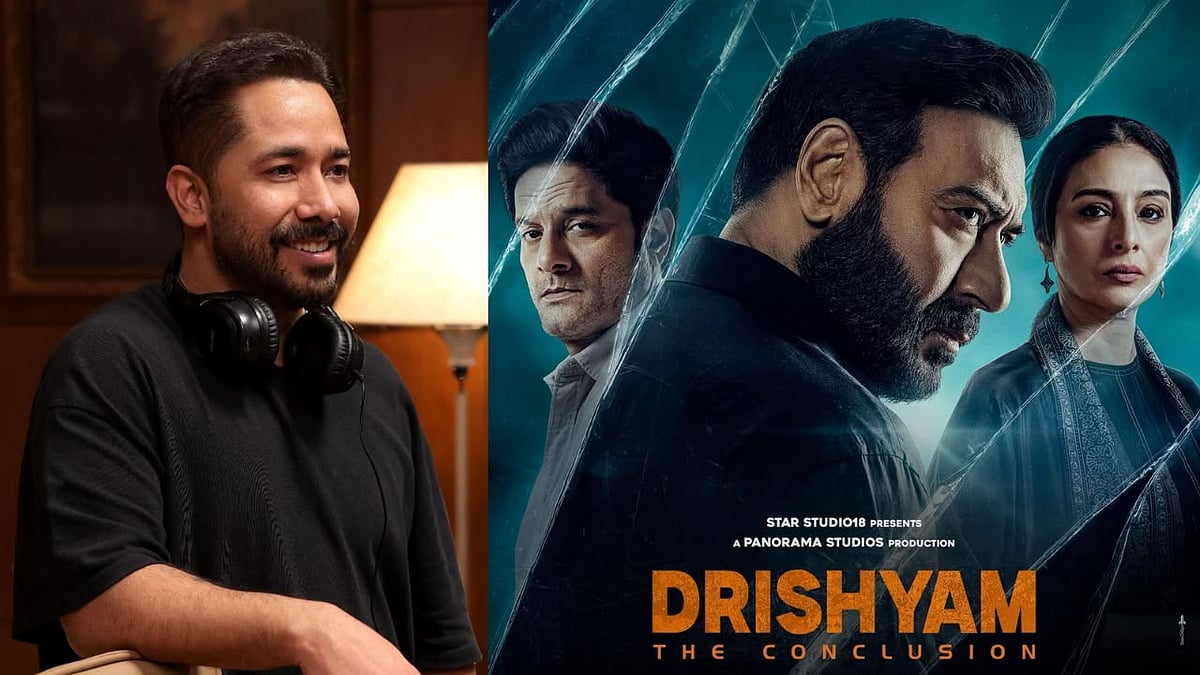
Ajay Devgn once again fits comfortably into the role of Vijay Salgaonkar.
His restrained performance works because Vijay is supposed to be difficult to read. There is very little visible emotion on his face, which makes even a small change in expression feel meaningful.
Shriya Saran also gets moments where Nandini’s behaviour becomes important to the larger mystery. Her performance becomes particularly relevant when the story begins revealing what the family has been carrying internally.
Jaideep Ahlawat brings the strongest fresh energy to the film. His Rajveer Singh Tomar has a different personality from the officers we have seen before. Ahlawat gets several memorable moments, including a particularly tense sequence involving Anju’s marriage meeting.
His presence makes the investigation feel fresh, even though the overall structure remains familiar.
Prakash Raj clearly enjoys playing the confident lawyer who believes he can intimidate everyone in the room. His scenes are intentionally loud and theatrical, matching the film’s larger-than-life tone.
Tabu, meanwhile, brings the emotional weight of Meera Deshmukh back into the story. Her character continues to carry the pain of a mother who never received closure, although the film could have used more of her.
When Vijay’s Morality Starts Getting Complicated
There are moments when the film seems ready to take Vijay into darker territory.
His famous determination to do anything for his family begins to look less like protection and more like obsession. Some of his choices suggest that he could eventually become the kind of person he has spent the franchise trying to defeat.
But Drishyam ultimately refuses to go that far.
Vijay may manipulate people, hide evidence and bend the law, but the film still wants the audience to see him as a fundamentally decent family man.
That is an important distinction. The story allows Vijay to operate in morally grey territory without turning him into a traditional antihero.
His distrust of the justice system explains much of his behaviour. Vijay understands that the law often works through evidence and appearances, while his own situation exists somewhere between those two extremes.
He also understands that an ordinary man like him is unlikely to be believed when confronted by people with greater power, money and influence.
Drishyam: The Conclusion Review
What makes Drishyam: The Conclusion work is that it understands what audiences have come to expect from this franchise.
The film isn’t really interested in proving that truth will always win. Instead, it explores how a convincing version of the truth can become more powerful than the truth itself.
Vijay is a storyteller, and his greatest skill is controlling the story other people believe.
That idea gives the franchise its identity.
The film may not completely escape the repetition that comes with a third instalment, and some twists are easier to anticipate than the filmmakers probably intend. The background score can still be overbearing, and several sequences lean heavily into melodrama.
But despite those flaws, Drishyam: The Conclusion remains an entertaining thriller.
It doesn’t reinvent the franchise. It doesn’t need to.
Instead, it takes the familiar Salgaonkar formula, adds a new investigator, revisits old wounds and gives audiences another elaborate game of deception.
For a franchise built around the power of a well-constructed lie, that may be exactly the point.
Also Read:- The Vvaan Movie Review: A Fantasy Drama That Struggles to Find Its Own Identity
About the Author




2 thoughts on “Drishyam: The Conclusion Review: Ajay Devgn’s Thriller Still Keeps You Guessing”