
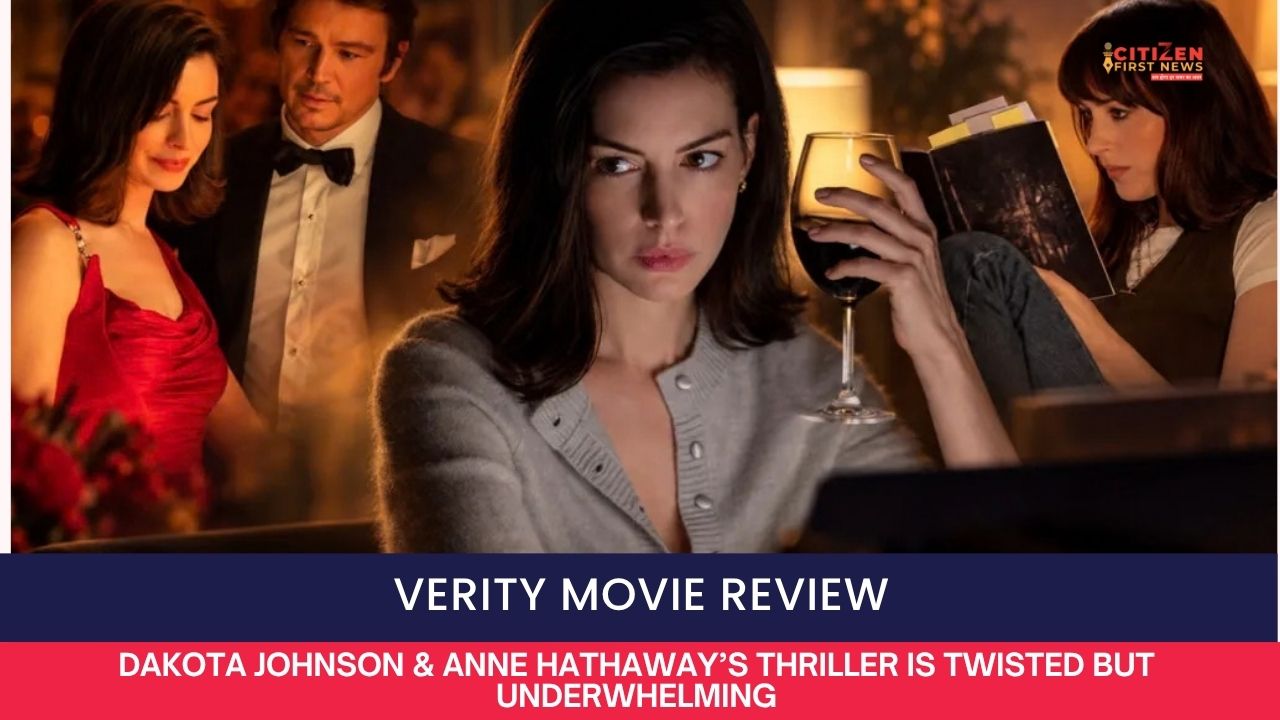
Verity Movie Review
Verity Movie Review: Lowen Ashleigh, a struggling writer played by Dakota Johnson, is offered a strange but potentially career-changing assignment. She is hired to complete the unfinished work of Verity Crawford, a hugely successful novelist who is unable to write after a terrible accident.
Lowen travels to the Crawford family’s secluded home in Vermont and meets Verity, who is confined to a wheelchair and appears incapable of communicating.
At first, everything seems straightforward.
Then Lowen notices Verity moving.
It’s only a brief moment, but it changes everything. If Verity is genuinely paralysed, how did she turn her head? Was Lowen simply exhausted and imagining things, or has Verity been hiding the truth from everyone around her?
That question becomes the driving force behind the film.
Table of Contents
A House Full of Secrets
Lowen’s job quickly turns into something much more disturbing when she discovers an unpublished manuscript hidden among Verity’s belongings.
What she reads isn’t another work of fiction.
The manuscript appears to be a deeply personal account of Verity’s life, revealing disturbing thoughts about her marriage, motherhood and the death of one of her children.
From this point, Verity starts jumping between the present and the past.
The flashbacks gradually reveal the complicated history of Verity and her husband Jeremy, while the present-day story follows Lowen as she tries to understand what really happened inside the Crawford household.
The film’s central strength lies in this uncertainty. Almost every character becomes questionable, and the audience is constantly encouraged to reconsider what they think they know.
Dakota Johnson’s Lowen Doesn’t Quite Connect
Dakota Johnson gives Lowen a deliberately quiet personality.
The character is shy, introverted and not particularly comfortable in social situations, so the subdued performance initially feels appropriate.
The problem is that the performance rarely develops beyond that initial restraint.
As Lowen discovers increasingly disturbing information, there are moments when you expect fear, panic or suspicion to take over. Instead, her reactions can feel surprisingly muted.
That makes it difficult to become fully invested in her journey.
Lowen is supposed to be the audience’s guide through this increasingly bizarre situation, but the emotional distance in the performance sometimes works against the suspense.
Anne Hathaway Steals the Attention
Anne Hathaway is arguably the most interesting element of the film.
Even though Verity spends much of the present-day story in a largely unresponsive state, Hathaway’s character dominates the atmosphere.
The flashback sequences give her an opportunity to show a much darker side of Verity. She brings a calculated, unsettling quality to the character, making it difficult to determine whether Verity is a victim, a manipulator or something in between.
That ambiguity works particularly well.
Josh Hartnett also fits comfortably into the role of Jeremy.
He initially appears to be a grieving husband and devoted father, but there is always enough uncertainty around him to make you wonder whether his seemingly perfect behaviour is genuine.
The film wisely avoids giving straightforward answers too early.

The Setting Creates the Right Mood
The Crawford home is one of the film’s strongest visual elements.
Set beside a lake and surrounded by an otherwise peaceful landscape, the house initially feels beautiful and isolated rather than frightening.
But as Lowen learns more about the family, the same surroundings begin to feel increasingly uncomfortable.
The contrast between the calm environment and the disturbing secrets hidden inside the house gives the film much of its atmosphere.
The production design does a good job of making the location feel important to the story rather than simply functioning as a backdrop.
Where the Film Starts Losing Its Way
Unfortunately, the promising setup isn’t maintained throughout.
The film takes a long time to reach its destination, and the middle portion occasionally feels repetitive. Instead of continuously raising the tension, the narrative sometimes pauses to revisit information the audience has already understood.
The dialogue can also be uneven.
Some conversations successfully create suspicion, while others sound more like exposition designed to explain the plot.
That becomes increasingly noticeable as the film approaches its final act.
The Big Reveal Doesn’t Hit Hard Enough
For a psychological thriller like Verity, the ending is everything.
The entire story is built around one major question: who is telling the truth?
The film eventually provides its answer—or at least attempts to.
The problem is that the final revelation doesn’t have the impact it should.
The setup promises a shocking, morally complicated conclusion that could completely change how viewers interpret the characters. Instead, the final stretch feels somewhat flat.
There is certainly material here for a much more sinister ending, but the direction doesn’t quite squeeze enough tension out of the reveal.
Rather than leaving you stunned, the finale is more likely to leave you debating whether the buildup was worth the payoff.

Verity Movie Review
Verity has a strong premise and enough mystery to keep things interesting for much of its runtime.
The isolated setting works, Anne Hathaway gives the film an appropriately chilling presence, and Josh Hartnett keeps his character intriguingly ambiguous.
But the movie is held back by uneven pacing, some clumsy dialogue and a central performance that doesn’t always deliver the emotional intensity the story demands.
Most importantly, the ending doesn’t match the promise of the setup.
If you’re a fan of psychological thrillers built around secrets, unreliable characters and questionable versions of the truth, Verity still offers enough to keep you watching. Just don’t expect the final twist to completely blow you away.
Rating: ⭐⭐⭐/5
Also Read:- Drishyam: The Conclusion Review: Ajay Devgn’s Thriller Still Keeps You Guessing
About the Author