


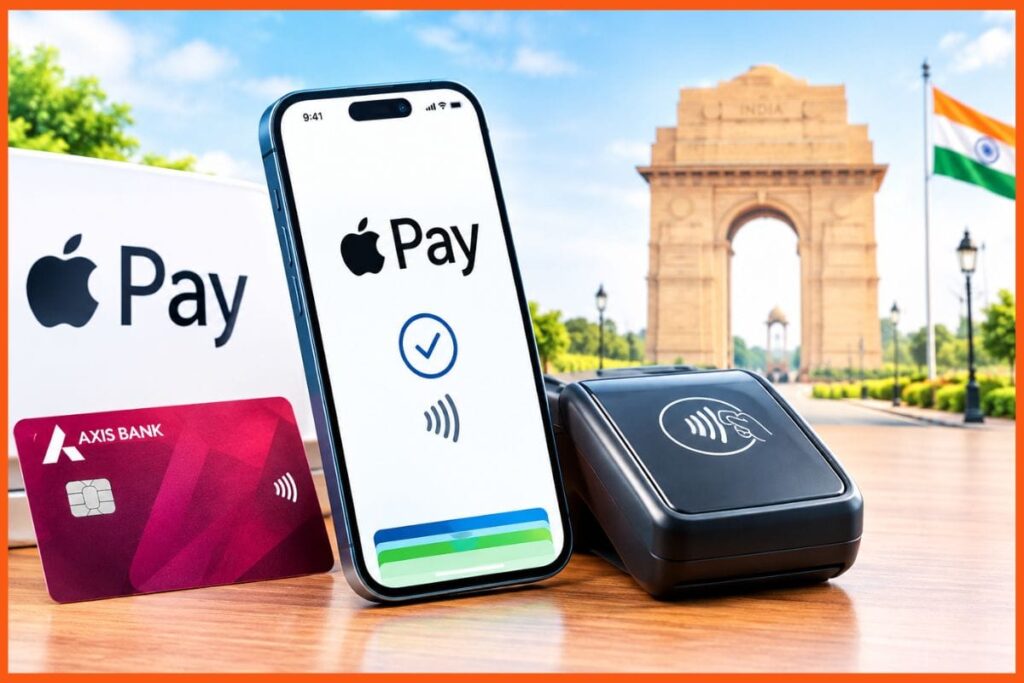
Apple Pay Comes to India: Apple has officially brought Apple Pay to India, entering a digital payments market where UPI has already become the preferred way for millions of people to make everyday transactions. Axis Bank is the first Indian bank to support Apple’s payment service at launch.
Table of Contents


Apple Pay Comes to India: What’s Available
Apple Pay became available in India on September 30, 2026. At the initial stage, the service is limited to eligible Axis Bank Visa and Mastercard credit cards.
The service does not currently support RuPay cards, debit cards, American Express cards or credit cards issued by other banks.
Apple Pay can initially be used on iPhone, iPad and Apple Watch, while support for Mac is expected to be introduced later.
Axis Bank customers can add an eligible card through the Axis Bank app or Apple Wallet. Once added, the card can be used for contactless payments at compatible NFC terminals, as well as on supported apps and websites.
How Apple Pay Will Work in India
Unlike UPI, Apple Pay does not directly transfer money between two bank accounts. Instead, it uses the user’s linked credit card to process the payment.
That means successful transactions will depend on both the card being supported and the merchant’s payment infrastructure being compatible with Apple Pay.
During the early phase of the rollout, users could therefore find that Apple Pay works at one contactless terminal but isn’t accepted at another, even when they are using an eligible Axis Bank card.


Why Other Major Banks Are Missing
The delayed participation of some of India’s biggest card issuers appears to be linked partly to commercial negotiations.
According to earlier reports, Apple has been seeking a transaction fee of around 20 basis points, or 0.20%, from the payments ecosystem.
India’s card-payment infrastructure generally operates on considerably smaller margins, reportedly around 40–50 basis points. Apple’s proposed share could therefore represent a significant portion of the available revenue.
As negotiations continue, HDFC Bank, ICICI Bank and SBI Card are not part of the initial Apple Pay rollout.
Apple, Axis Bank, HDFC Bank, ICICI Bank and SBI Card had not responded to requests for comment cited in earlier reports.
Apple Pay vs UPI in India
Apple Pay is entering a market very different from the one it operates in across many other countries.
UPI dominates India’s digital payment ecosystem, with QR codes and direct bank-account transfers now widely used for everyday purchases.
Apple Pay, meanwhile, is entering through the credit-card segment, initially focusing on customers with eligible premium cards.
While that makes its initial reach narrower than UPI, Apple Pay could still provide Apple with another way to generate services revenue from India’s expanding iPhone user base.


Apple Expands Its India Strategy
The launch also comes as Apple continues to increase its presence in India.
Apple accounted for around 28% of India’s smartphone market by value in 2025, compared with 23% the previous year, according to industry data cited in earlier reports.
India has also become an increasingly important manufacturing base for Apple. Around a quarter of the company’s global iPhone production is now reported to come from India, with estimates suggesting the country’s share could reach 30–35% over the next five years.
The arrival of Apple Pay adds another element to Apple’s growing India strategy, alongside expanding iPhone sales, local manufacturing and the company’s growing retail footprint.
Also Read:- Adnan Sami on Udta Teer Joke: “Pehle Mujhse Rights Lo Aur Phir Film Banao”